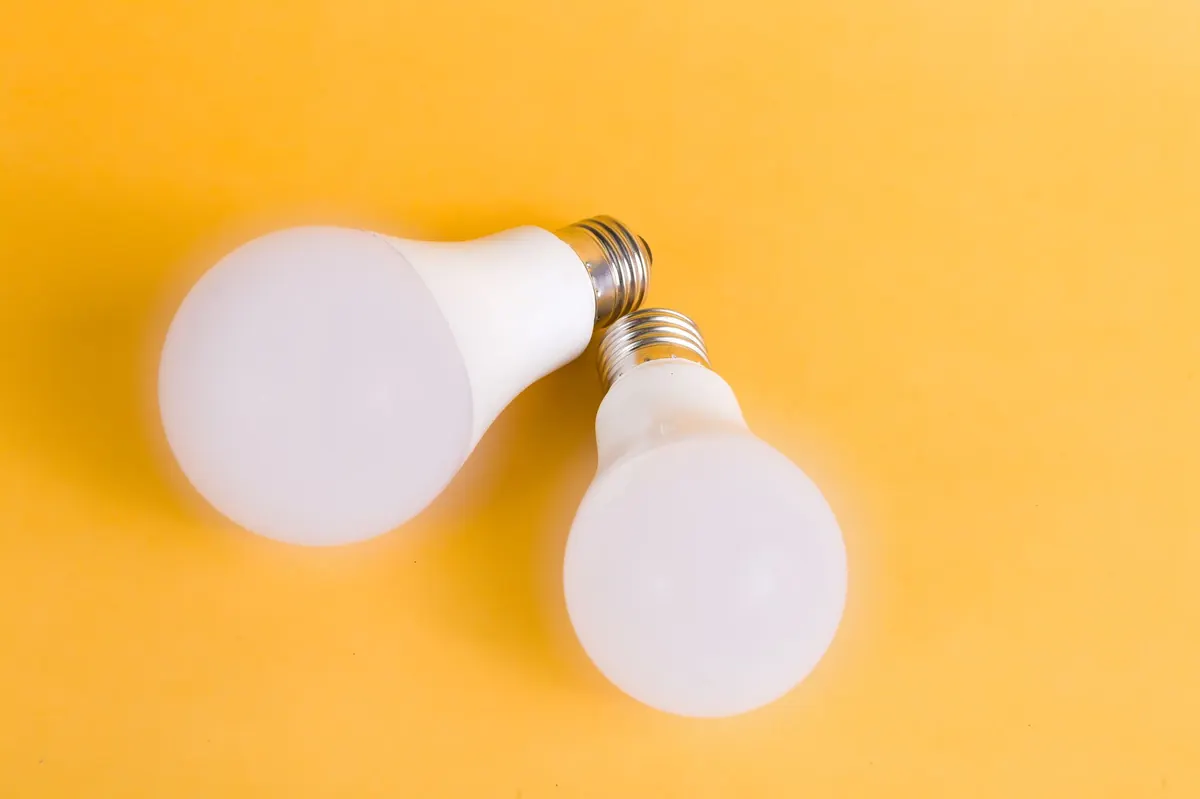
Six hundred lumens. Four thousand kelvins. CRI 90. A lantern's spec sheet reads like a lab report, and most shoppers skim it, grab the biggest number, and hope. Then the power goes out, or the tent zips shut, and you find out what you actually bought: a light that is bright but harsh, or warm and cozy but too dim to find the matches.
The three specs on the box do three different jobs. Lumens describe how much light comes out. Kelvins describe what color it is. CRI describes whether the world under it still looks like the world. Learn them once and every listing gets easier to read.
A lumen measures total visible light output. Wattage used to be the shorthand, but watts describe how much electricity a bulb eats, not how much light it gives back. That's why packaging switched to lumens years ago.
Here's the part that trips people up: brightness perception isn't linear. Going from 50 to 100 lumens looks like a real jump. Going from 500 to 550 looks like nothing at all. Roughly, you need about four times the output to make a light look twice as bright, so compare lanterns in steps — 100, 400, 800 — rather than by small differences.
Lanterns also spread light differently than flashlights do. Most sit or hang and glow through a globe or half-globe, which softens the beam and lights a whole tent or table instead of one spot. A frosted 300-lumen lantern often lights a small room more usefully than a bare 500-lumen emitter pointed at one wall.
As a rough guide:
Peak output and runtime pull against each other. The battery that runs a lantern for many hours at 60 lumens may hold its highest mode only briefly, so read the runtime printed next to each mode, not the headline number. If the maker cites a testing standard such as ANSI/FL1 (now often written ANSI/PLATO FL1), the figures were measured the way other brands measure theirs, which makes comparison fair. A max-lumen claim with no standard behind it is a marketing number.
Color temperature, measured in kelvins, describes how warm or cool light looks. Counterintuitively, lower numbers are warmer. It's the biggest factor in how a lantern feels, even when the lumens are identical.
The working rule is warm for evenings, cool for work. Cooking, sorting gear, reading a map, or opening a first-aid kit all go better under cooler light, where edges and colors separate more clearly and most people feel more alert. Dinner, conversation, and winding down go better warm, where a tent stops feeling like an operating room. Many good lanterns offer both ends of the range, sometimes on a stepless dial.
One caution: bright, blue-rich light late at night is the kind that tends to keep people awake, so lean warm and dim before sleep. If you have a sleep disorder or an eye condition, that's a conversation for a clinician, not a spec sheet.
CRI stands for color rendering index, a 0–100 score for how faithfully a light shows colors against a natural reference. A low-CRI lantern can be perfectly bright and still turn a red jacket brown, make fresh food look tired, and hide dark blue cord against a dark floor. That matters more than most buyers expect: reading a colored map, judging whether meat is cooked, checking a child's skin tone during an illness.
Incandescent and halogen bulbs score near 100 by nature; LEDs vary widely. Roughly, below 80 is mediocre, 80–89 is acceptable, 90 and up is good, and 95+ is excellent. Two caveats. CRI averages several pastel test colors, so a lamp can score 90 and still render reds poorly — some makers now quote R9, the red-specific score, or use a newer metric called TM-30. And very warm or very cool light tends to render color less accurately, so a 90+ rating at 2,700K is a different achievement than the same number at 4,000K.
For cooking, first aid, and anything involving color, aim for CRI 90 or higher. Cheap LEDs often carry a green or magenta cast that no number fully captures, so read reviews that mention tint, or buy from a seller with easy returns.
When you compare two lanterns, work through them like this:
Runtime and dimming. A lantern that holds a moderate output all night beats one that spikes briefly. If an outage runs from dinner to breakfast, you want a low, steady mode measured in tens of lumens and many hours.
A 1,200-lumen burst that dies in twenty minutes is dimmer in practice than 400 lumens that last until morning.
Diffusion is the other one. Frosted globes, reflectors, and hanging loops turn a harsh point source into room-filling light. Check the water and dust rating too: an IPX4 lantern shrugs off rain, while an IPX7 one survives a dunking. And check whether it remembers your last setting — reaching for a lantern at 2 a.m. and getting a blast of 1,000 lumens is nobody's idea of helpful.
Tent or bedside: 50–200 lumens, 2,200–3,000K, CRI as high as your budget allows. Camp table and cooking: 300–800 lumens, 3,000–4,000K, CRI 90+. Outages and group spaces: 800–1,500 lumens bounced off a ceiling, neutral white, long runtime. Porch ambience: low output, warm white, diffused.
Buy for the mode you'll leave running for hours, not the one printed in the biggest font. The best lantern is the one you stop thinking about, because the light is exactly
Photo: Riki Risnandar / Pexels
A practical checklist for lakeside lantern releases: permits, biodegradable materials, written wind limits, launch...
Rust on an old lantern is usually surface damage, not a death sentence. Here's how to clean, polish and reseal one...
Layer floor, tabletop, and hanging lanterns at three heights with one warm bulb color to build depth and warmth...

Bright ideas and beautiful lanterns for every space..
