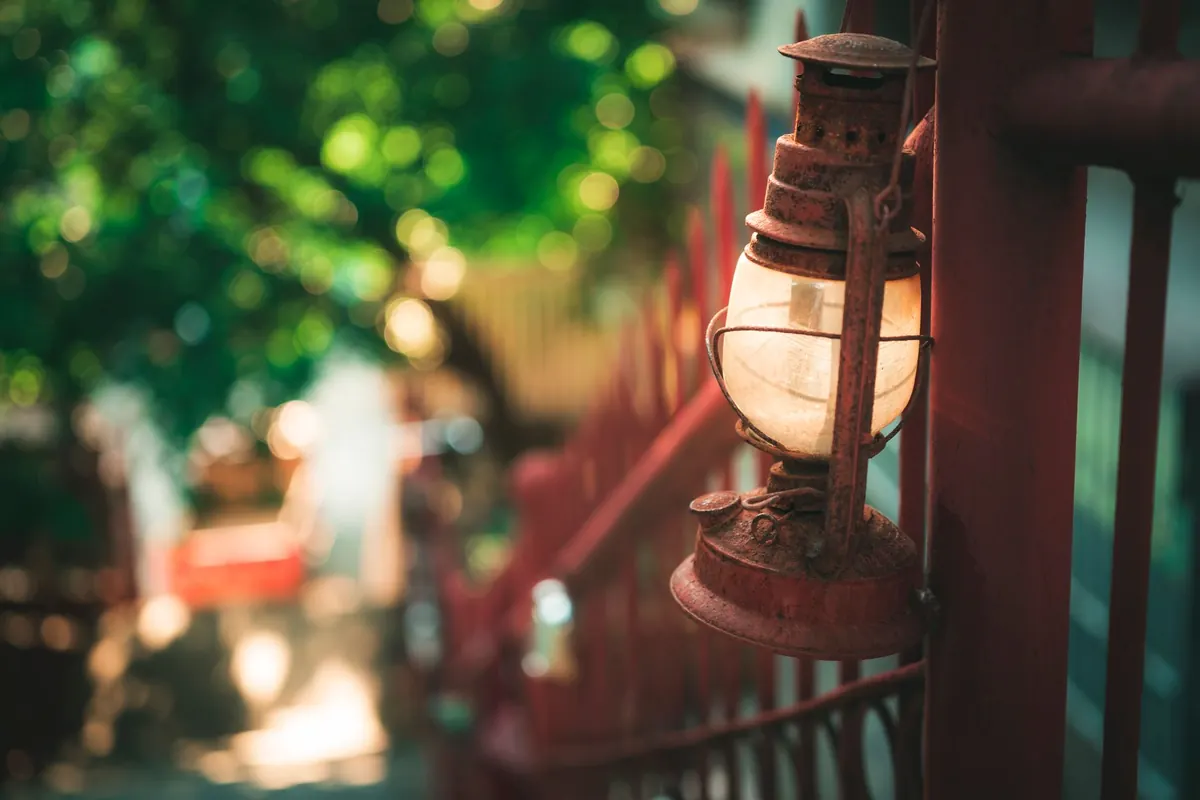
When the power drops, most of us reach for whatever light is closest. In one house that's a plastic LED lantern from the hardware aisle; in another it's a kerosene lantern that has hung in the garage for twenty years. Both will get you through the evening. But they behave so differently — in brightness, smell, risk, and cost — that keeping the wrong one for your situation is a small decision you'll notice every time the grid goes down.
These two lights are not really competing for the same job. They overlap in the middle, and outside that middle one of them clearly wins.
A wick lantern is a simple machine: fuel, wick, glass chimney, flame. It never needs a battery, never needs a charger, and its output doesn't drop as the night wears on. It also produces heat, a faint kerosene smell, and carbon monoxide — which matters more than anything else in this comparison.
An LED lantern is a battery, a driver circuit, and a cluster of diodes. It turns on instantly at full brightness, can usually be dimmed, and gives off almost no heat. Its weakness is the battery itself: it needs charging, it degrades over years, and in a long outage a cheap lantern with tired alkalines will fade long before you're ready.
LED lanterns are rated in lumens, and the numbers are honest. A modest 100-lumen lantern is enough to eat dinner by. A 400- to 600-lumen model lights a whole room well enough to read, play cards, or sort through a first-aid kit. It's white light, sometimes a little cold, and it spreads evenly.
Kerosene gives you warm, yellow-orange light in a soft pool. A flat-wick lantern is bright enough to read by if you sit close to it, but it won't fill a room; step six feet away and you're in shadow. Pressurized mantle lanterns throw far more light, but they hiss, they run hot, and they demand more attention. If your outage plan involves one lamp per room, LEDs will simply do a better job. If you want a low, steady glow for the kitchen table, kerosene is pleasant in a way LEDs aren't.
Runtime is where the trade-off flips depending on how you've prepared.
A flat-wick kerosene lantern typically burns through a full tank in a night or a bit more, depending on wick height. Refueling is quick, but you need fuel on hand — and fuel has a shelf life and storage rules. A single gallon or four liters stored properly in an approved container will carry you through several nights of one-lantern use.
An LED lantern's runtime depends entirely on the setting and the cells inside it. The pattern to remember:
The practical trick is to run the lantern low and point it at the ceiling. Bounced light fills a room with a fraction of the power.
This is the section worth reading twice. Kerosene lanterns burn fuel, and burning fuel indoors produces carbon monoxide, plus soot and a smell that lingers in curtains and upholstery. Never run a kerosene lantern in a closed bedroom or a sealed room. If you use one inside, do it in a space with real ventilation, keep it away from anything that can catch, and never leave it burning while you sleep.
LED lanterns have no combustion risk at all. Their hazards are smaller: cheap models can overheat if charged badly, and any lantern left on the floor is a trip hazard in the dark. Battery safety is mostly about using the right charger and not storing leaking alkalines in a device for years.
If anyone in the house develops a headache, dizziness, or nausea while a fuel lantern is burning, get everyone into fresh air immediately and seek medical advice.
Kerosene needs to be stored in an approved container, away from heat and out of reach of children. Refuel a lantern only when it's cool — never over a live flame, and never indoors near a pilot light. Trim the wick and clean the chimney; a sooty chimney cuts light output noticeably. Check your local rules for storing flammable fuel, and if you're unsure about ventilation in a specific room, treat it as unsafe and use the LED there instead.
Purchase price is the least interesting number here. What matters is cost per evening of light.
Kerosene has a fuel cost every time you burn it, plus occasional wicks, chimneys, and mantles. Over a decade of occasional outages, that adds up, but it's spread thin and predictable.
LEDs cost more up front for a good model, then almost nothing if you run rechargeables. Disposable alkalines are the expensive path — a long outage can eat a pack of batteries in a couple of nights. A small solar panel or a charged power bank turns the running cost into effectively zero. If you're budgeting, put your money into one quality LED lantern and a set of rechargeable cells rather than four cheap lanterns.
Most homes are better off with LEDs as the primary light and kerosene, if any, as a backup for heat and atmosphere. A quick way to decide:
Emergency lighting fails because of storage, not design. Run through this once, then again when you change the clocks:
Then put the LED lantern where you can find it without a flashlight. That single habit — a known shelf, a tested battery, a spare set of cells beside it — matters more than which of the two technologies you picked.
Photo: Xiang Qi / Pexels

A practical checklist for lakeside lantern releases: permits, biodegradable materials, written wind limits, launch...
Lumens, kelvins and CRI decide how bright a lantern feels, what color its light casts, and whether you can tell red...
Rust on an old lantern is usually surface damage, not a death sentence. Here's how to clean, polish and reseal one...

Bright ideas and beautiful lanterns for every space..
